
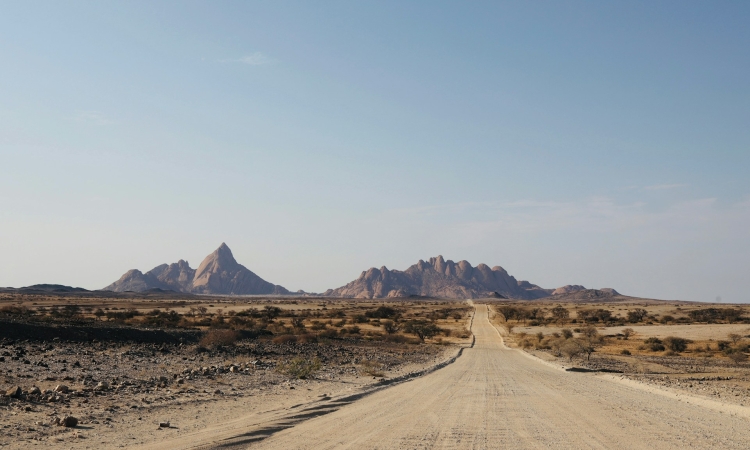
Tourism in Spitzkoppe plays an important role in Namibia’s travel industry, especially for visitors interested in nature, geology, and culture. Spitzkoppe is located in Namibia’s Erongo region and is known for its wide open landscapes and large granite rock formations. It is often called the Matterhorn of Namibia because of the pointed shape of its main peak.
Spitzkoppe, which means pointed dome in German, can be seen from the B2 road that links Swakopmund and Windhoek. The highest peak, Gross Spitzkoppe, rises to about 1,728 meters above sea level. Together with the nearby natural rock arch, it is one of the most photographed places in the country.
A key reason tourism in Spitzkoppe is popular is the rock formations. These granite peaks were formed millions of years ago and show clear signs of long geological history. The best known features are the main pointed peak and the Pontok Mountains, a group of sharp granite hills that stand out on the horizon.
The granite at Spitzkoppe has a pink tone caused by minerals such as feldspar and quartz. This color becomes stronger during early morning and late afternoon, making these times popular for photography.
Even though the area looks dry, Spitzkoppe supports plant and animal life that has adapted to desert conditions. One well known plant is the Welwitschia mirabilis, which grows in the Namib Desert. Birdlife is also important for tourism in Spitzkoppe. Species such as Verreaux’s eagle, gregarious weaver, Rufous vented Warbler, Rueppell’s Bustard, Layard’s Warbler, and Stark’s Lark have been recorded. Around 151 bird species have been identified in the area.
Small animals such as rock hyraxes, known locally as dassies, are often seen on the rocks. These animals are known for their ability to move across steep cliffs and rocky surfaces.
Spitzkoppe also has strong cultural value. Ancient San communities used the rocks as shelters and sacred places. There are at least 37 known rock art sites in the area. These paintings show hunting scenes, animals, and spiritual themes. Visits to the rock art sites are only allowed with a guide and can be arranged at reception.
Overall, tourism in Spitzkoppe combines nature, history, and culture, making it an important destination for travelers visiting Namibia.


