
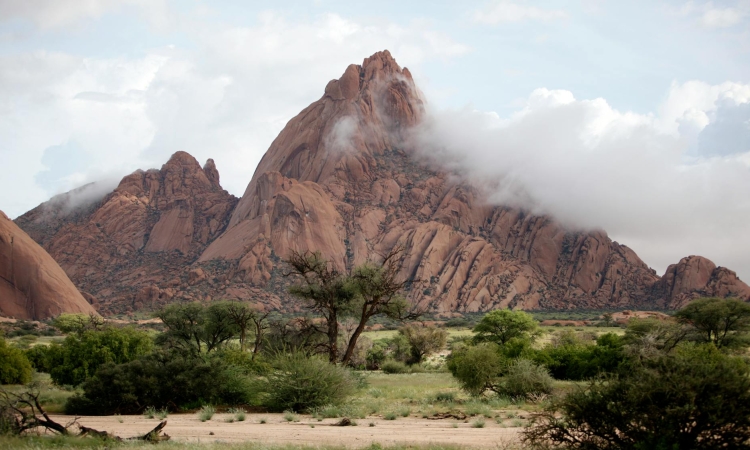
The history of Spitzkoppe is closely linked to Namibia’s geology, early human settlement, and the development of mountaineering in southern Africa. Spitzkoppe, which means sharp head in German, is one of Namibia’s most recognized landmarks. It is located northeast of Swakopmund, between Swakopmund and Usakos, about 50 kilometers away, in the Namib Desert.
Spitzkoppe rises alone from the flat desert plains and reaches about 1,728 meters above sea level. Because of its pointed shape, it is often called the Matterhorn of Africa. This comparison refers only to its shape, as Spitzkoppe is a granite inselberg and not a snow covered mountain. Nearby is Little Spitzkoppe, which stands at about 1,584 meters above sea level.
Geologically, Spitzkoppe is the remains of an ancient volcano. It developed in a similar way to the Brandberg and the Erongo Mountains. Over millions of years, erosion exposed the hard granite core, creating the sharp peaks seen today.
Long before modern climbers arrived, the area around Spitzkoppe was home to San communities. These early people used the rocks as shelters and sacred places. Many rock surfaces are decorated with Bushmen rock art showing animals, hunting scenes, and spiritual symbols. These paintings are an important part of the history of Spitzkoppe and provide insight into early life in the desert.
There is a legend that the first ascent of Spitzkoppe happened in 1904, when a Royal Schutztruppe soldier is said to have climbed the peak alone and lit a fire on the summit. Since there is no natural fuel at the top, it is not clear what he burned. According to the story, he never returned, and no proof of this climb has ever been found.
The first confirmed ascent took place in 1946. It was led by S. le Roux and a group of climbers from Cape Town. Early attempts were slow and difficult. Some climbers were stopped by smooth granite sections only a few meters high and had to carve steps into the rock using tools.
In later years, climbers such as Hans and Else Wong and Jannie de Villiars Graaf reached the summit. For many decades, Spitzkoppe was known as a climb that could take two or three days. This changed in 1971 when a team led by J. W. Marchant from the University of Cape Town Mountain and Ski Club reached the top in just four hours.
Another important feature in the area is Pondok Mountain, which has a chain that helps visitors reach Bushman’s Paradise, a natural rock basin.
Today, Spitzkoppe is a protected conservation area under Namibia’s MET. Campsites are managed by a local women’s cooperative, and guides are available to help visitors explore the area. The history of Spitzkoppe continues to be preserved through conservation, guided visits, and respect for its cultural heritage.


